02 July 2026 by Ditas A. Antenor
The Red Pen.
We spend our lives remembering the big moments, only to discover that it was the little ones that quietly changed us.
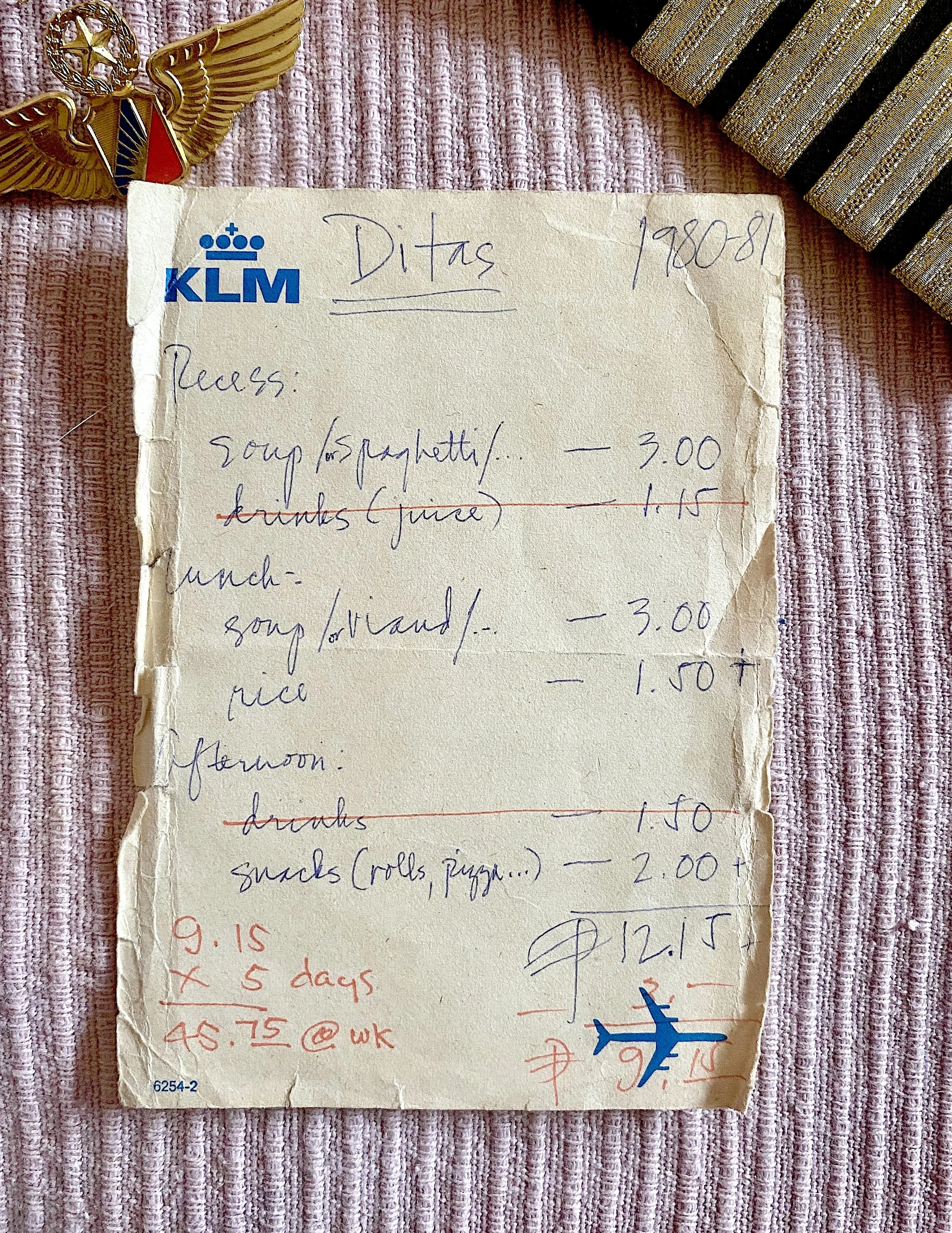
A few days ago, while going through a small box of keepsakes my late mother had carefully tucked away over the years, I found a tiny envelope.
Inside was a slip of paper no bigger than the palm of my hand.
It was my handwriting.
1980-1981.
I was still in high school.
My dad used to ask me, from time to time, what my daily food expenses were in school. I suppose he wanted to know whether my allowance was enough or needed adjusting.
Written in blue ink were my estimates:
Recess
Meal + drinks
Lunch
Meal + drinks
Afternoon snack
Meal + drinks
Then I noticed something that made me laugh.
Every single "drinks" had been neatly crossed out.
Not in my blue ink.
In my dad's unmistakable red pen.
I stared at that tiny note for several minutes, smiling.
Sometimes, a parent's greatest lessons aren't spoken. They're quietly edited into our lives.
My dad had an interesting life before he became a commercial airline pilot. He was a boxer in his younger years—as many tough young Filipino men of his generation and background were—before joining the Philippine Air Force as a pilot. Discipline wasn't something he talked about; it was simply how he lived. Fitness, self-control, and purpose were woven into his daily life.
Yet he also came from very humble beginnings, where every peso mattered and nothing unnecessary was taken for granted.
So why did he cross out "drinks"?
Was he simply being frugal?
Or was he quietly telling his teenage daughter that soft drinks and sweet juices weren't necessities?
I'll never know.
The funny thing is, I never questioned it.
I never complained.
I simply accepted the revision and carried on.
Ironically, I didn't always follow that quiet lesson.
In my early twenties, I developed the terrible habit of grabbing an ice-cold bottle of Coke straight from the refrigerator on my way to work. More often than not, that was breakfast.
It eventually landed me in the hospital with an ulcer.
That experience cured me of the habit for good.
Some lessons take years to understand. Others wait patiently until life teaches them a second time.
Today, I rarely drink sugary beverages.
No soft drinks.
No sweetened juices.
No sugary iced teas.
Water has long become my drink of choice, and I honestly don't miss the rest.
Looking back, I sometimes wonder whether that little note had something to do with it.
Perhaps not directly.
Perhaps it was simply one small thread woven into years of quiet parenting.
Parents often think the lessons their children will remember are the big conversations, the carefully planned advice, or the occasional lecture.
But life has a way of preserving different memories.
Sometimes it's a habit they modeled without realizing it.
Sometimes it's an offhand remark.
And sometimes...
it's a single word crossed out in red ink.
The smallest edits we make in the lives of those we love may become the longest-lasting chapters of their story.
Today, doctors tell us to limit sugary drinks. Nutritionists remind us to reduce our sugar intake. Wellness experts encourage healthier choices.
My dad never gave me any of those lectures.
He simply crossed out one word.
Forty-six years later, I found that little piece of paper tucked safely inside my mom's keepsake box.
I laughed when I saw it.
Then I quietly thanked both of my parents.
My mom, for saving what most people would have thrown away.
And my dad, for leaving behind a lesson so small that neither of us could have known it would still be speaking to me decades later.
27 May 2026 by Ditas A. Antenor
No Longer Available for the Noise
“Absence is not always bitterness. Sometimes, absence is wisdom.”
A quiet memory from a solemn tea ceremony in Sakai, Japan years ago:
matcha, wagashi, and the kind of stillness I understand more deeply now.
I recently came out of a two-day work project: a rare occurrence now, because I have already retired.
But some invitations are difficult to decline. This one came from longtime friends and a longtime respected client. These are relationships I value. So I showed up, did the work, and packed up happily tired.
While I was busy, I realized I had been almost completely oblivious to the latest national spectacle: the crying, the yelling, the dramatics, the walkouts, the endless noise from people who seem to mistake performance for public service.
And strangely, I felt relieved.
Not because these things do not matter. They do. But because I had been spared, even briefly, from the emotional fatigue of watching duty turn into theater.
Perhaps I recognized it too well.
Because the noise from the Senate felt uncomfortably familiar: not in scale, of course, but in spirit. The dramatics. The posturing. The sudden righteousness. The endless need to perform for an audience.
And I found myself thinking: who needs this?
More specifically, who needs this in a batch?
At this stage in life, why should a high school batch feel like politics? Why should friendship require strategy? Why should belonging come with factions, pressure, and carefully managed narratives?
What should have been simple, familiar, even joyful, slowly became political. There were sides. There were narratives. There were messages flying through Messenger and Viber. There were tensions, accusations, and carefully worded calls for “unity” that often felt less like healing and more like pressure.
Pressure to agree.
Pressure to compromise.
Pressure to appear gracious.
Pressure to comply.
And yes, in some ways, we complied.
We participated in a process we felt was unnecessary and divisive. We stayed civil. We followed what was required. We did our part, even when the atmosphere no longer felt kind.
But compliance has limits.
We can be gracious without being pressured into silence.
There was also pressure to accept certain people back into a space I had built and tended for years — a space with its own history, rhythm, and standards.
I did not make a scene. I did not announce a rejection. I simply stood my ground.
I neither accepted nor declined.
Eventually, the requests were withdrawn.
Not surprisingly, another space was created elsewhere.
So be it.
Because at some point in life, we must learn the difference between being cooperative and being diminished.
I think of Meryl Streep before The Devil Wears Prada, walking into a room where she was not immediately seen as enough. Too old, perhaps. Not glamorous enough, perhaps. Not what they had imagined.
But she knew her value.
She did not shrink to fit the room. She did not beg to be chosen. She understood what she brought with her : the years, the discipline, the weight of her work, the quiet authority of someone who had earned her place.
There is a lesson there.
We can participate without losing ourselves.
We can respect a process without pretending that the process did not leave marks.
We can remain composed without becoming available to every demand.
Compliance is not surrender.
Silence is not consent.
Absence is not defeat.
Perhaps some experiences do leave a mark. Not always a wound. Sometimes, simply a clarity.
And my clarity now is this:
I want peace.
I want quiet.
I want laughter with real friends. I want meaningful work, good coffee, unforced conversations, and days that do not require decoding hidden motives or surviving another round of group tension.
I no longer miss the noise.
I no longer feel the need to attend every meeting, answer every narrative, or prove my sincerity to people determined to misunderstand it.
There is a kind of peace that comes when you stop explaining yourself to rooms that have already decided what story they prefer.
There is also a kind of freedom in choosing where your presence belongs.
And perhaps that is what I am learning now.
Not every invitation deserves attendance.
Not every noise deserves response.
Not every pressure deserves compliance.
Sometimes, stepping away is not bitterness.
Sometimes, it is discernment.
And sometimes, the most powerful thing a woman can say — after years of showing up, doing the work, carrying the weight, and staying composed under pressure — is simply this:
I have done my part.
Now, I choose my peace.
24 April 2026 by Ditas A. Antenor
What We Build, We Tend
“Not that I built something remarkable, but that I stayed.”
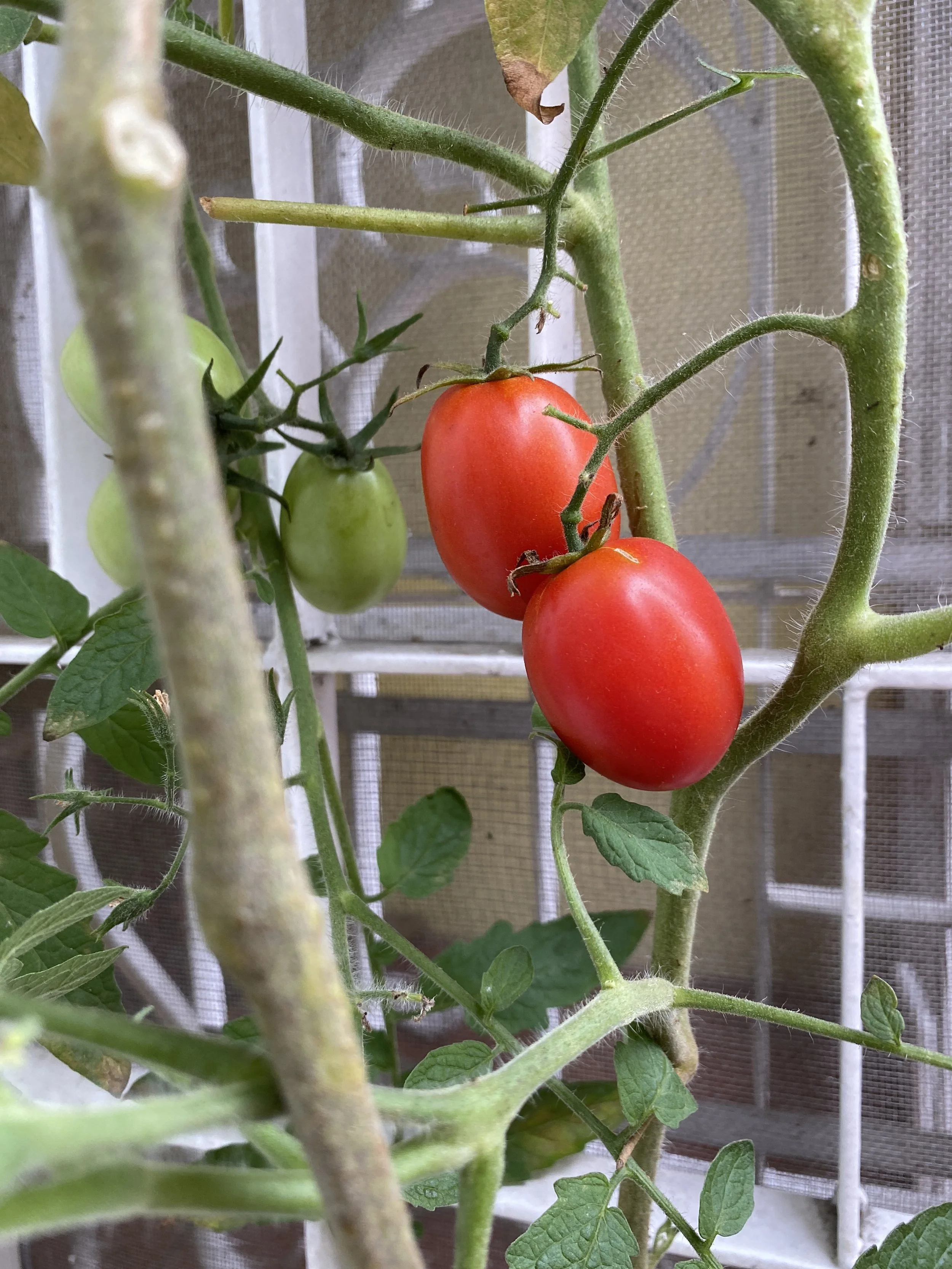
Growth happens in its own time. My tomatoes in my garden.
This year, last month, one of the online communities I created quietly marked its seventh anniversary.
Seven years may not sound like a lifetime, but in the life of a community, it is long enough to see patterns form: to witness growth, resilience, and the small daily acts that keep people connected.
It also made me pause and think about another online community I started many years earlier, one that has now been part of my life for eighteen years.
In 2008, I created an online group for my high school batch. Social media was still new then, and the intention was simple: to reconnect classmates and keep friendships alive despite distance and busy lives.
Over time, that small group became part of our shared history: a place where milestones were celebrated, losses were mourned, and friendships were sustained through the years.
Looking back now, I realize that both communities, though very different in purpose, taught me the same lesson.
Communities do not thrive simply because they are created.
They thrive because they are tended.
Years later, in our neighborhood in BF Homes, I created another kind of community: this time centered on everyday life. In 2019, The HomeSarap Community was born.
Residents could connect with home-based cooks, small vendors, and service providers. What began as a practical solution quickly became something more meaningful. The community grew steadily, and with it came stories of neighbors helping one another in quiet, practical ways.
And then, quite unexpectedly, the 2020 pandemic arrived.
Just a few months after the community was created, the COVID lockdown began. People could not go out for food. Businesses were forced to close. Movement was restricted, and uncertainty filled the air.
Almost overnight, the group took on a different role. It became a source of daily meals for families who were staying at home, and just as importantly, a source of livelihood for vendors and delivery riders who suddenly found themselves without income.
What had started as a simple neighborhood platform slowly evolved into something much larger: an ecosystem of people supporting one another, each playing a role in keeping the community moving forward during a difficult season.
Encouraged by its success, we tried to bring the same idea to other locations: Merville, Alabang, Pasig, the Northeast, etc.
Some communities grew steadily. Others remained small.
And that, too, was a lesson: not every community develops in the same way.
Growth depends on trust, culture, and consistent care.
Almost overnight, a simple group became a lifeline.
It became more than a group.
It became an ecosystem.
Growth depends on trust, culture, and care.
Along the way, I also learned that leadership sometimes requires difficult decisions.
There were moments when I had to step in to protect the tone and values of a community after concerns were raised about how people were being treated. It was not an easy time, and emotions ran high—including my own.
I reacted in anger.
And later, I apologized.
That experience stayed with me. It reminded me that the tone we set, especially in moments of tension, shapes the culture of the community more than any rule ever could.
Over time, I have come to understand that communities are very much like ecosystems.
They grow in seasons.
They require patience.
And they thrive when people continue to show up, even when the work is quiet and unseen.
Owning mistakes is part of leadership.
Growth begins with humility.
A few years ago, during harvest season in my own garden, I filmed a short video while gathering vegetables that had taken months to grow. Watching it again recently, I was reminded of something simple: you plant, you wait, you care for what grows: and you trust that the harvest will come in its own time.
Leadership, I have learned, is not always about keeping everyone happy.
Sometimes it is about protecting what matters, even when the decision is misunderstood.
Communities, after all, are living things.
They reflect the character of the people who nurture them.
And perhaps that is what these milestones— seven years in one community, eighteen years in another— have quietly taught me.
Not that I built something remarkable,
but that I stayed.
And perhaps that is the quiet work of this season of life:
not to chase attention,
but to care for what has already been entrusted to us.
To tend what we have built.
Protecting what matters is part of leadership.
Every harvest begins with someone who stayed.
My tomatoes in my garden.
You plant, you wait, you trust the harvest.
21 March 2026
by Ditas Antenor
Choosing lightness. Choosing clarity.
Choosing peace.
What I Let Go.
*
What I Let Go. *
Life does not become smaller when we let go.
It becomes clearer.
There was a time when I thought holding on was strength.
Holding on to people.
To expectations.
To stories that were not mine, but I was expected to answer for.
If I stayed long enough…
understood enough…
adjusted enough…
maybe everything would make sense.
But not everything is meant to be understood.
And not everything is meant to be carried.
__________________________
I used to hold on to explanations.
The need to clarify.
To correct what was said.
To fix what was misunderstood.
Especially when the narratives were not mine.
False narratives… quietly repeated,
until they begin to sound like truth.
Nakakapagod din pala,
to keep explaining yourself
to people who have already decided who you are.
So I learned to step back.
Not because it didn’t matter,
but because I matter too.
__________________________
I let go of spaces
where asking a question
was mistaken for disruption.
Where clarity felt unwelcome,
and silence was preferred.
So I stepped back.
And slowly, I found my way back to myself.
__________________________
I let go of the need to be included everywhere.
Because not all invitations are aligned.
Not all access is meaningful.
And not all presence is necessary.
And that’s okay.
__________________________
I let go of performing kindness.
Hindi ko pala kaya.
I cannot smile warmly at someone
and then speak differently behind closed doors.
It feels dishonest.
So now, I choose something simpler:
Respect, always.
Warmth, when it is real.
Distance, when it is needed.
__________________________
And maybe most of all,
I let go of the need to be understood by everyone.
Because not everyone will.
And not everyone is meant to.
And there is a certain peace in that.
__________________________
These days, life feels lighter.
Not because everything is perfect,
but because I am no longer carrying
what was never mine to begin with.
I still care.
I still show up.
I still love deeply.
But now, I choose where.
And I choose with more confidence,
and a quieter kind of strength.
__________________________
Letting go, I’ve learned,
is not about losing.
It is about making space
for better conversations,
for healthier relationships,
for a life that feels more like your own.
And perhaps this is what this season is really about:
Not holding on tighter…
but moving forward
with a little more ease,
a little more wisdom,
and a heart that is still open.
Because the truth is,
Life does not become smaller when we let go.
It becomes clearer.
24 February 2026
by Ditas Antenor
What I Keep.
On Turning Sixty-Three.
Today I turn sixty-three.
I don’t feel dramatic about it. I don’t feel fragile either. I simply feel aware.
Aware of how much has been lived.
Aware of what no longer needs to be carried.
There was a time when birthdays felt like report cards. What have I built? What have I achieved? What have I survived?
Now the question is gentler.
Does this still feel like me?
Last year, I stepped away from something I had once given my energy to wholeheartedly. I didn’t leave in anger. I left because something inside me had grown clearer.
In the quiet that followed, I realized something freeing:
Not every story requires my correction.
People will have their versions. Memories shift. Perspectives differ. I used to feel responsible for clarifying everything, for making sure the narrative was accurate.
I don’t anymore.
I know what I said.
I know what I meant.
I know who I am.
At this age, that knowing is steady enough.
So here is what I keep.
I keep my standards.
I keep the courage it took to speak when it was inconvenient.
I keep the grace it took to step back when staying would have cost me peace.
I keep my sleep.
I keep my joy.
There were seasons for building, proving, defending. I am grateful for them. They shaped me.
But this season feels different.
This is the season of selecting.
I select where my energy goes.
I select conversations that feel reciprocal.
I select rooms where I can be fully myself without explanation.
Energy is precious. I no longer spend it trying to win arguments or chase applause. I would rather spend it on family, meaningful work, long conversations, quiet mornings.
Success now looks simple.
It looks like sleeping well.
It looks like laughing easily.
It looks like no longer rehearsing explanations in my head.
It looks like peace that does not need witnesses.
Sixty-three does not feel like a summit.
It feels like a vantage point.
From here, I see the storms I survived, as a mother, as a woman, as someone who rebuilt more than once. I see the love that endured. I see strength that was earned slowly, quietly.
And ahead, I see space.
Space to choose carefully.
Space to live lightly.
Space to be present: selectively, intentionally, fully.
If you are entering your sixties, wondering if you are “behind” or “too much” or “not enough,” let me tell you this:
You are not.
You are seasoned.
You are discerning.
You are allowed to choose peace over performance.
We have earned the right to keep what strengthens us and release what diminishes us.
Sixty is not a decline. It is a refinement.
And there is something deeply beautiful about a woman who no longer needs to prove — only to choose.
The Finest Souvenir
Some trips are measured by the landmarks you visit. Others are measured by the moments that quietly change the way you see the world.
Singapore surprised me not because of its famous skyline, but because it reminded me that travel is richest when we slow down enough to notice the stories hidden between the attractions. From learning family recipes in strangers' homes across different countries to wandering through neighborhoods where history still lingers, I realized that the finest souvenirs have never been things I could pack in a suitcase—they've always been the experiences that stay with me long after I return home.
Why I Travel Beyond Postcards
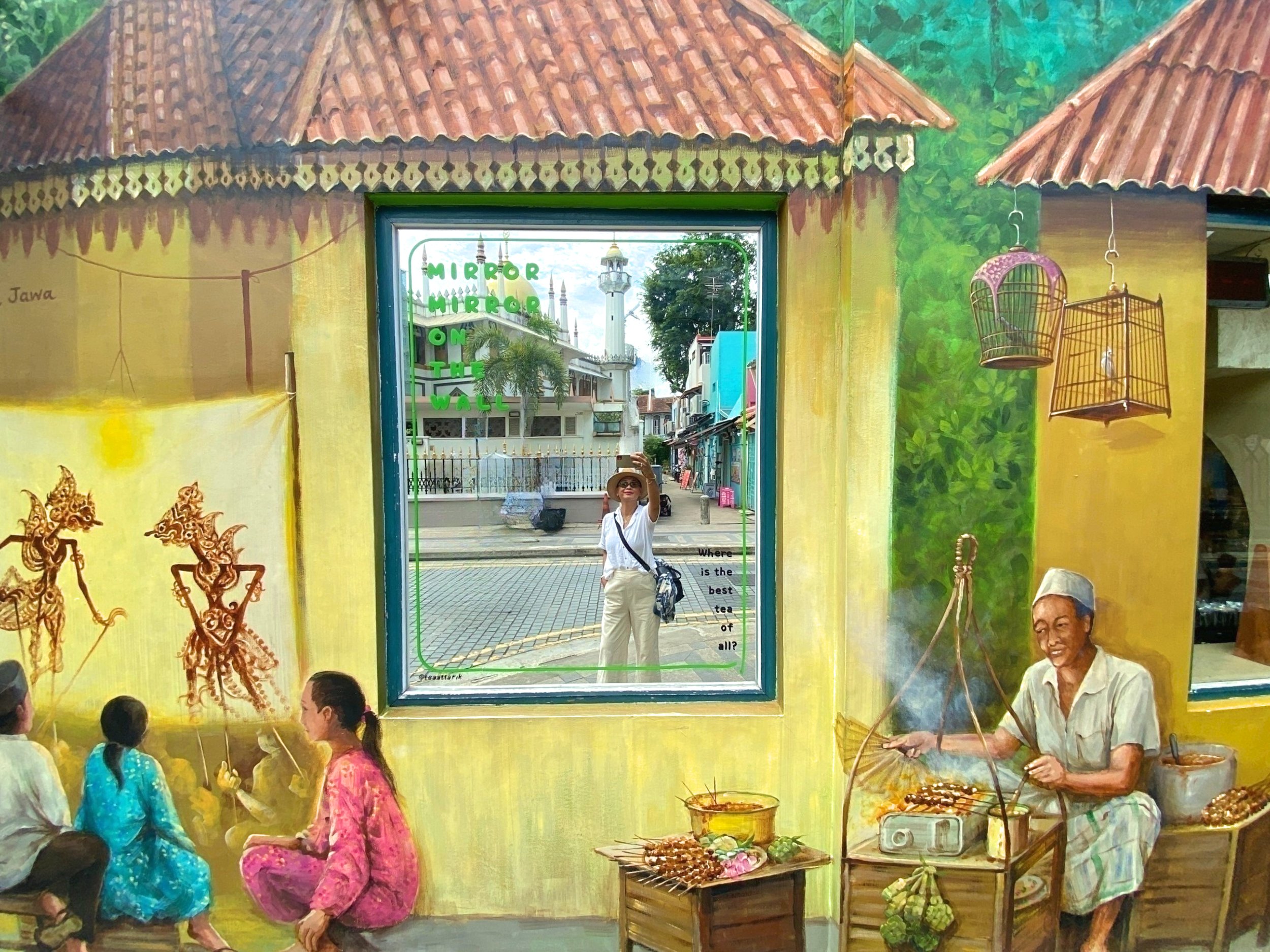
Kampong Glam, Singapore
I've been fortunate to travel since childhood, but somewhere along the way, I realized that I wasn't traveling simply to see more places.
I was traveling to know them.
Growing up with a father who was an airline pilot, overseas travel wasn't an occasional luxury—it was simply part of life. My mother and I often accompanied him on his training programs and work trips abroad. Those journeys taught me how to navigate airports, read maps, and plan itineraries long before GPS and smartphones existed.
More importantly, they shaped the way I see the world.
Looking back, I realize the clues were always there.
As a child, I learned to make pasta from the owner of the pensione where we stayed in Italy and appeltaart from another gracious hostess in Amsterdam. Years later, an Airbnb host in Ireland welcomed me into her kitchen and shared her family's shepherd's pie. In Bali, I even persuaded my friends to spend a day in a local family's home learning Indonesian cooking instead of spending another afternoon at the beach.
At the time, those experiences felt like unrelated adventures.
Today, I see them as chapters of the same story.
I've never been satisfied with simply tasting a country's food. I want to know where it came from, who prepares it, why it's made that way, and what it reveals about the people who call that place home.
Food, after all, is history you can taste.
Architecture is history you can walk through.
Neighborhoods are history still being lived.
"Food is history you can taste. Architecture is history you can walk through. Neighborhoods are history still being lived."
That is exactly what I found in Singapore.
Like everyone else, I admired the skyline, the immaculate streets, and the city's remarkable efficiency. But the places that stayed with me were those beyond the postcards.
I wandered through Joo Chiat, admiring beautifully preserved Peranakan shophouses whose intricate façades reflect the blending of Chinese and Malay traditions.
I explored Kampong Glam, where Malay, Arab, and contemporary influences coexist so naturally that every street feels like a conversation between the past and the present.
In Chinatown, I looked beyond the bustling souvenir stalls. I found temples filled with quiet devotion, long-standing family businesses, traditional Chinese calendars still hanging inside neighborhood shops, and reminders of the immigrants whose perseverance helped shape modern Singapore. The deeper I looked, the more I realized that the city's Chinese heritage isn't something preserved behind glass. It's alive in everyday life.
Even Tiong Bahru, with its understated Art Deco buildings and peaceful residential streets, reminded me that a city's character is often found where ordinary people live rather than where tourists gather.
Some of my favorite photographs weren't of famous landmarks.
They were of weathered windows.
Ornate floor tiles.
Old signboards.
Doorways polished by decades of use.
The afternoon light falling across an otherwise ordinary street.
Details that many visitors might simply walk past.
To me, those details were the city introducing itself.
"Sometimes a city introduces itself not through its landmarks, but through its ordinary streets."
Traveling alone made those moments possible.
I've traveled solo for many years—not because I prefer being alone, but because I treasure the freedom it offers. Freedom to linger in a museum after everyone else has moved on. Freedom to photograph the same row of shophouses from five different angles. Freedom to turn down an unfamiliar lane simply because it catches my eye. Freedom to change my plans without worrying that I'm slowing someone else down.
Curiosity has its own pace.
Solo travel allows me to keep it.
One of the experiences I had looked forward to most was spending a day with an elderly Singaporean cook who had agreed to teach me Hainanese Chicken Rice—not in a commercial kitchen, but in his own home. One-on-one.
A masterclass.
The plan was simple: visit the market together, return to his kitchen, and cook one of Singapore's most iconic dishes from start to finish.
It wasn't just a cooking class; it was a glimpse into a way of life.
When it was cancelled midway through my trip, I was disappointed.
But only briefly.
The city, as it turned out, had other stories waiting for me.
Looking back, that felt strangely appropriate.
The best moments of my travels have rarely been the ones I planned most carefully.
They've been the conversations I never expected to have.
The welcoming hosts who generously shared their homes.
The neighborhood I almost skipped.
The museum exhibit that made me linger.
The side street that invited me to wander.
"The itinerary gives a journey its structure. Curiosity gives it its soul."
I returned home with photographs, certainly.
But I also came home with a deeper appreciation of how Chinese, Malay, Indian, and Peranakan influences have woven together to create Singapore's unique identity.
More importantly, I came home reminded of something that has quietly guided me for most of my life.
I don't travel to collect countries.
I don't travel to tick attractions off a list.
And I don't travel to find myself.
I travel because every place has a story waiting to be understood.
If I'm willing to slow down, ask questions, wander a little farther, and look a little closer, that story eventually reveals itself.
The finest souvenir isn't something you can buy.
It isn't something you can pack.
It's the feeling that, for a little while, a place that was once unfamiliar begins to feel like home.
And to me, that has always been the greatest reward of traveling.
No Longer Available for the Noise
A reflection on pressure, boundaries, and the quiet freedom of no longer being available for the noise.
I recently came out of a two-day work project: a rare occurrence now, because I have already retired.
But some invitations are difficult to decline. This one came from longtime friends and a longtime respected client. These are relationships I value. So I showed up, did the work, and packed up happily tired.
While I was busy, I realized I had been almost completely oblivious to the latest national spectacle: the crying, the yelling, the dramatics, the walkouts, the endless noise from people who seem to mistake performance for public service.
And strangely, I felt relieved.
Not because these things do not matter. They do. But because I had been spared, even briefly, from the emotional fatigue of watching duty turn into theater.
Perhaps I recognized it too well.
Because the noise from the Senate felt uncomfortably familiar: not in scale, of course, but in spirit. The dramatics. The posturing. The sudden righteousness. The endless need to perform for an audience.
And I found myself thinking: who needs this?
More specifically, who needs this in a batch?
At this stage in life, why should a high school batch feel like politics? Why should friendship require strategy? Why should belonging come with factions, pressure, and carefully managed narratives?
What should have been simple, familiar, even joyful, slowly became political. There were sides. There were narratives. There were messages flying through Messenger and Viber. There were tensions, accusations, and carefully worded calls for “unity” that often felt less like healing and more like pressure.
Pressure to agree.
Pressure to compromise.
Pressure to appear gracious.
Pressure to comply.
And yes, in some ways, we complied.
We participated in a process we felt was unnecessary and divisive. We stayed civil. We followed what was required. We did our part, even when the atmosphere no longer felt kind.
But compliance has limits.
We can be gracious without being pressured into silence.
There was also pressure to accept certain people back into a space I had built and tended for years : a space with its own history, rhythm, and standards.
I did not make a scene. I did not announce a rejection. I simply stood my ground.
I neither accepted nor declined.
Eventually, the requests were withdrawn.
Not surprisingly, another space was created elsewhere.
So be it.
Because at some point in life, we must learn the difference between being cooperative and being diminished.
I think of Meryl Streep before The Devil Wears Prada, walking into a room where she was not immediately seen as enough. Too old, perhaps. Not glamorous enough, perhaps. Not what they had imagined.
But she knew her value.
She did not shrink to fit the room. She did not beg to be chosen. She understood what she brought with her : the years, the discipline, the weight of her work, the quiet authority of someone who had earned her place.
There is a lesson there.
We can participate without losing ourselves.
We can respect a process without pretending that the process did not leave marks.
We can remain composed without becoming available to every demand.
Compliance is not surrender.
Silence is not consent.
Absence is not defeat.
Perhaps some experiences do leave a mark. Not always a wound. Sometimes, simply a clarity.
And my clarity now is this:
I want peace.
I want quiet.
I want laughter with real friends. I want meaningful work, good coffee, unforced conversations, and days that do not require decoding hidden motives or surviving another round of group tension.
I no longer miss the noise.
I no longer feel the need to attend every meeting, answer every narrative, or prove my sincerity to people determined to misunderstand it.
There is a kind of peace that comes when you stop explaining yourself to rooms that have already decided what story they prefer.
There is also a kind of freedom in choosing where your presence belongs.
And perhaps that is what I am learning now.
Not every invitation deserves attendance.
Not every noise deserves response.
Not every pressure deserves compliance.
Sometimes, stepping away is not bitterness.
Sometimes, it is discernment.
And sometimes, the most powerful thing a woman can say — after years of showing up, doing the work, carrying the weight, and staying composed under pressure — is simply this:
I have done my part.
Now, I choose my peace.